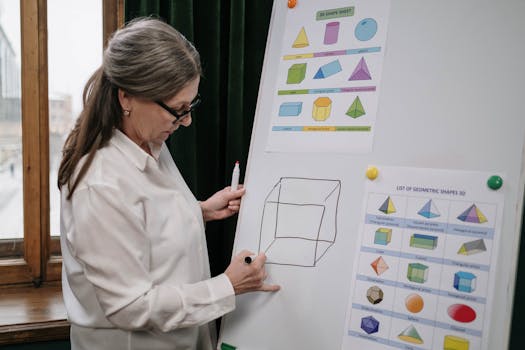

Are we merely delivering content, or are we fostering genuine mathematical comprehension? In an era where passive consumption dominates, the challenge of cultivating active, engaged learners in mathematics has never been more critical. For educators and curriculum designers alike, the quest for effective pedagogical strategies often leads to the exploration of interactive methods. But what truly constitutes an interactive math lesson, and how can we move beyond superficial gamification to embed deep conceptual understanding? This exploration delves into the nuanced implications of implementing thoughtful, impactful tips for creating interactive math lessons.
Beyond Click-and-Drill: Defining True Mathematical Interactivity
It’s crucial to distinguish genuine interactivity from mere digital flash. True interactivity in a math lesson isn’t just about clicking buttons or dragging elements; it’s about prompting learners to think, experiment, conjecture, and reason. It involves creating environments where students are not just recipients of information but active participants in its construction and application. This means designing experiences that:
Encourage Exploration: Providing tools or scenarios where students can manipulate variables, test hypotheses, and discover mathematical relationships independently.
Promote Problem-Solving: Presenting authentic problems that require more than rote memorization, pushing learners to strategize and apply multiple concepts.
Facilitate Collaboration: Designing activities that necessitate communication, discussion, and shared discovery among peers.
Offer Immediate Feedback (with Meaning): Not just confirming right/wrong, but explaining why an answer is correct or incorrect, guiding students toward correction.
Integrating Manipulatives and Visualizations: The Tactile-Digital Bridge
One of the most potent tips for creating interactive math lessons revolves around the judicious use of manipulatives and visualizations. While physical manipulatives have long been a staple, digital tools now offer unprecedented possibilities. Think beyond static diagrams; consider dynamic geometry software that allows students to stretch, transform, and observe the consequences in real-time.
The Power of “What If”: Tools like GeoGebra or Desmos enable students to ask “what if” questions and immediately see the graphical or numerical results. For instance, when teaching quadratic functions, students can manipulate the coefficients of $y = ax^2 + bx + c$ and observe how the parabola’s shape, position, and orientation change. This visual feedback loop solidifies abstract concepts.
Bridging Concrete to Abstract: Digital manipulatives, whether virtual blocks for fractions or interactive number lines, can serve as a crucial bridge for students transitioning from concrete experiences to abstract mathematical reasoning. The key is to ensure these tools are integrated with deliberate pedagogical intent, not just as a digital substitute.
Designing for Inquiry-Based Learning: Fostering Mathematical Curiosity
A cornerstone of effective tips for creating interactive math lessons is the adoption of an inquiry-based approach. Instead of presenting theorems and formulas as established facts, learners are guided to discover them through investigation. This cultivates a deeper, more resilient understanding.
Uncovering Patterns: Presenting a series of data points or a geometric construction and asking students to identify underlying patterns. For example, instead of stating the Pythagorean theorem, students could be given various right triangles and asked to find a relationship between the side lengths.
Strategic Questioning: The educator’s role shifts from dispenser of knowledge to facilitator of discovery. Asking open-ended questions, probing student thinking, and encouraging them to justify their reasoning are paramount. “How do you know that?” or “What makes you think that?” are far more powerful than a simple “Is that right?”.
Leveraging Technology for Personalized Learning Pathways
The advent of adaptive learning platforms and intelligent tutoring systems offers remarkable opportunities for personalization, a critical element in effective tips for creating interactive math lessons. These tools can assess student understanding in real-time and adjust the difficulty, pace, and type of content presented.
Targeted Interventions: When a student struggles with a particular concept, adaptive software can automatically provide additional practice, targeted explanations, or alternative approaches. This frees up the educator to work with small groups or individual students needing more direct support.
Differentiated Instruction: Interactive platforms allow for a greater degree of differentiation. Students who grasp concepts quickly can be presented with more challenging problems or extension activities, while those who need more time can receive additional scaffolding. This ensures every student is appropriately engaged.
The Collaborative Classroom: Peer-to-Peer Mathematical Discourse
Learning is inherently a social process, and fostering collaboration is a vital, yet often underestimated, aspect of tips for creating interactive math lessons. When students explain concepts to each other, articulate their reasoning, and debate different approaches, their own understanding is profoundly deepened.
Think-Pair-Share, Amplified: This classic strategy can be enhanced with interactive tools. Students might solve a problem individually using a digital whiteboard, then discuss their solutions with a partner, and finally share their collective insights with the larger group via a collaborative online document.
Constructive Conflict: Encouraging healthy debate around mathematical ideas can be incredibly powerful. When students encounter differing viewpoints, they are forced to re-examine their own assumptions and solidify their understanding through logical argumentation.
Final Thoughts: Cultivating Mathematical Fluency Through Active Engagement
The implications of thoughtfully implemented tips for creating interactive math lessons extend far beyond mere engagement metrics. They speak to a pedagogical philosophy that prioritizes conceptual understanding, critical thinking, and problem-solving skills – competencies that are increasingly vital in our complex world. By embracing dynamic tools, fostering inquiry, personalizing learning, and championing collaboration, educators can transform mathematics from a subject to be endured into a discipline to be explored and mastered. It’s about shifting the paradigm from passive reception to active construction, empowering learners to become confident, capable mathematicians.